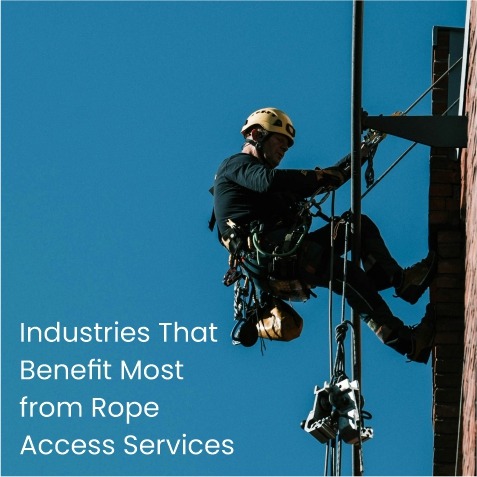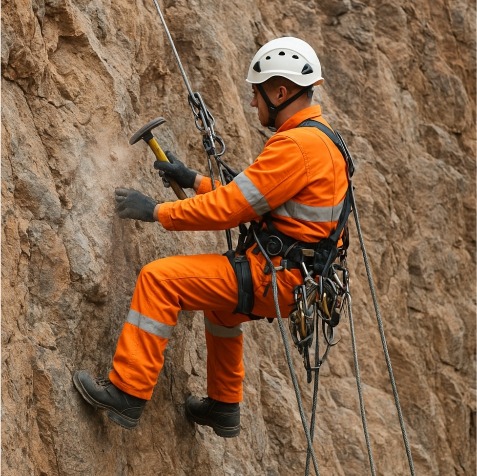
Geotechnical investigations and interventions on steep slopes, cliffs and cuttings present a unique access problem: the site you must study or fix is often the hardest place to stand. For engineers who need accurate, close-up data and targeted remediation, Geotechnical rope access methods are increasingly the preferred solution — combining safety, speed and minimal disruption to deliver reliable slope stability assessments and rockfall mitigation works.
______________________________________________________________________________________________________________
Why rope access matters for modern geotechnical work
Traditional access solutions — scaffolds, mobile platforms, heavy cranes or temporary roads — can be slow, expensive and environmentally intrusive. Rope access services for geotechnical projects let experienced technicians and geotechnical engineers work directly on the rock or soil face with minimal setup. The advantages include faster mobilization, reduced ecological footprint, and the ability to inspect or treat areas that would otherwise be unreachable without major civil works. Recent industry analyses show the rope access market growing quickly as infrastructure, mining and civil projects prioritise safer, more cost-effective ways to work at height.
______________________________________________________________________________________________________________
Core geotechnical applications for rope access
-
Site-scale inspections and data collection
Rope access enables detailed discontinuity mapping, joint and fracture surveys, point sampling, in-situ testing and photogrammetric surveys directly from the face. These close-range observations often reveal trigger features (e.g., exfoliation, undermined blocks, seepage paths) that remote or overhead surveys miss. Papers and practice notes highlight rope access as a high-value method in slope risk assessments and remediation monitoring.
-
Rockfall mitigation and removal
Where loose blocks pose an imminent hazard, rope teams can execute controlled removal (scaling), install anchors, bolts, or stitch blocks into place, and fit protective systems such as barriers or nets. These targeted interventions are faster to deploy and less disruptive than large-scale regrading. Case studies from industry providers show successful rockfall mitigation above critical infrastructure using rope techniques.
-
Installation & inspection of stabilization systems
Moreover, rope teams are ideal for installing and inspecting rock bolts, shotcrete patches, drainage measures, and mesh—especially in confined or steep environments (quarries, cuttings, hydropower intakes). Regular inspections by rope access technicians help validate the performance of remediation measures under real site conditions.
______________________________________________________________________________________________________________
How rope access improves slope stability workflows
-
Faster reconnaissance and safer diagnostics
A rapid rope access inspection can replace days of scaffold erection or earthmoving. With trained technicians and geotechnical engineers on ropes, teams can rapidly verify key design assumptions — material layering, joint orientation, weathering patterns — improving the confidence of slope stability models and design decisions. This on-face intelligence is particularly valuable where numerical models require accurate discontinuity and geometry inputs.
Because rope teams travel light and require minimal ground support, mobilization time and direct access costs are usually lower than heavy equipment alternatives. The combination of reduced site preparation, fewer specialist vehicles and quick deployment often shortens project timelines and lowers total cost of remediation.
-
Environmental and operational benefits
Rope access minimizes the need for earthworks, heavy lifting and ground disturbance—important when working near protected areas, hydropower assets, or active transport corridors. Additionally, rope access can be scheduled with minimal disruption to operations (railways, mines, roads) because it often requires only small exclusion areas rather than full closures.
______________________________________________________________________________________________________________
Technology and trends strengthening geotechnical rope access
- 3D photogrammetry & LiDAR from the face: In addition, close-range photogrammetric surveys and handheld/rig-mounted LiDAR capture as-built geometry for detailed rockfall simulations and monitoring. These datasets reduce uncertainty in kinematic and numerical analyses.
- Integrated monitoring systems: Additionally, coupling rope-access inspections with instrumented monitoring (inclinometers, crack meters, visual time-lapse) improves early-warning capability and verifies remediation effectiveness.
- Data-driven decision making: geotechnical teams increasingly use high-resolution face surveys together with rockfall frequency studies and statistical analyses to priorities interventions and quantify residual risk.
These trends mean rope access is no longer just an access technique — it’s a platform for data collection and precision intervention that feeds modern geotechnical practice.
______________________________________________________________________________________________________________
Real-world case study — mitigating rockfall above a hydro facility
When a hydropower facility experienced repeated rockfall events threatening critical assets, a specialist team used rope access to both assess and remediate the source slopes. Key points from the project:
- Problem: Frequent small-to-medium rockfalls originating from steep, highly weathered slopes (≈60°) directly above powerhouse structures. Conventional machinery access was unsafe because of powerlines and constrained site geometry.
- Rope access role: Initially, certified rope teams performed close-range mapping, removed unstable blocks by controlled scaling, installed rock bolts and mesh, and placed rock-fall barriers at key runout locations. Afterward, photographic and survey records were captured from the face to verify interventions.
- Outcome: As a result, targeted remediation eliminated the immediate hazard to the powerhouse with minimal project footprint and allowed the facility to resume operation quickly. Subsequently, follow-up inspections from ropes ensured quality control and verified barrier performance.
This example demonstrates how Geotechnical rope access services combine inspection, data collection and remediation in constrained, high-hazard settings.
______________________________________________________________________________________________________________
Safety, standards and competence
Rope access has a strong safety record when performed by trained, certified technicians operating under established systems (IRATA, SPRAT, industry guidelines). Organizations that combine rope access with geotechnical expertise ensure that rescue plans, anchor assessment, and geotechnical judgement are integrated into every intervention. For work where ropes are the primary support, it’s important to follow documented guidelines and have geotechnical supervision during interventions.
______________________________________________________________________________________________________________
Practical workflow: from reconnaissance to remediation
Step 1: Desktop study & risk prioritization
Gather available maps, aerial imagery, and previous reports to identify suspect slopes, probable failure mechanisms and sensitive assets.
Step 2: Rope access reconnaissance and detailed mapping
Deploy a rope team with geotechnical survey tools: joint/spacing measurements, high-resolution photography, and if needed, point sampling and in-situ tests.
Step 3: Modelling & mitigation design
Use the on-face data to inform kinematic checks, limit equilibrium or numerical models, and rockfall trajectory simulations.
Step 4: Targeted remediation by rope teams
Apply scaling, bolting, mesh, shotcrete patches or install barriers as designed. Keep interventions as localised as possible to reduce cost and impact.
Step 5: Verification & monitoring
Schedule follow-up rope inspections and instrument monitoring to validate remediation performance and detect changes early.
_____________________________________________________________________________________________________________
Measurable benefits (evidence-based)
- Faster project completion and lower mobilization: In fact, industry reports and providers note rapid setup and execution compared with scaffolding or heavy plant, resulting in reduced downtime and cost.
- Market growth reflects adoption: the global rope access market has shown steady growth as sectors seek safer and more economical access solutions for complex terrains. For example, analyses estimate market expansion from around USD 1.8 billion (2024) with solid projected growth through the decade.
- Better inspection quality: academic and industry case studies show rope access enables higher-confidence discontinuity mapping and actionable observations that materially change remediation design.
______________________________________________________________________________________________________________
When rope access may not be the best choice
While highly versatile, rope access is not a universal replacement. Large-scale regrading, heavy reconstruction, or interventions requiring continuous heavy plant may still require earthmoving and larger equipment. The optimum approach is often hybrid: use rope teams for diagnostics, targeted fixes and for access where heavy plant cannot reach, then bring in heavier methods only where strictly necessary.
______________________________________________________________________________________________________________
Conclusion — integrating rope access into geotechnical practice
Rope access is a mature, data-centric tool for modern geotechnical engineering. When combined with rigorous site investigation, modelling and monitoring, Geotechnical rope access services enable engineers to diagnose, prioritise and remediate slope hazards efficiently and safely. For projects where access is difficult, risk is high and disruption must be minimized, rope access offers a pragmatic, cost-effective alternative that improves decision quality and reduces downtime.
Call to action: Therefore, if your next slope stability assessment, rockfall mitigation project, or geotechnical inspection demands accurate, low-impact access, commissioning a certified rope access team with qualified geotechnical engineers is a smart choice. Early rope-based reconnaissance cuts uncertainty, lowers downstream cost, and often determines whether you get an approximate fix or a solution that works on the face.
______________________________________________________________________________________________________________
FAQ
Q1 — How does Geotechnical rope access differ from regular rope access?
A: Regular rope access describes the techniques and safety systems used to reach difficult places. Geotechnical rope access specifically pairs those access techniques with geotechnical tasks: discontinuity mapping, in-situ testing, rockfall source identification, and installation/inspection of stabilization systems. The focus is on geological and engineering data collection and remediation.
Q2 — Is rope access safe enough for critical infrastructure projects?
A: Yes — when performed by certified technicians under well-documented procedures and supervised by geotechnical engineers, rope access has an excellent safety record and is widely used for railways, highways, hydropower and mines. Industry guidelines and certification frameworks (IRATA / SPRAT and project-specific rescue and anchor protocols) underpin safe practice.
Q3 — Can rope access be combined with monitoring technologies?
A: Absolutely. Rope access is often used to install instruments (crack meters, tiltmeters) and to perform repeat photogrammetric or LiDAR surveys. This makes rope work an excellent way to both implement and verify long-term monitoring systems for slope stability and rockfall risk.