




When it comes to maintaining assets in the oil & gas, marine, and renewable energy sectors, challenges like extreme weather, restricted access, and hazardous environments are part of everyday operations. Traditional access methods—like scaffolding or heavy lifting platforms—often slow down work, increase risk, and drive-up costs.
This is exactly why rope access has become the preferred choice for offshore rigs, ships, refineries, ports, wind turbines, and energy facilities. And companies like Evolution Access Technologies deliver these solutions with certified IRATA professionals and industry-proven safety systems.
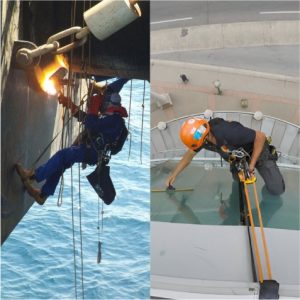
Offshore platforms, floating vessels, and wind farms have countless areas where installing scaffolding is nearly impossible. Rope access teams can reach verticals, confined spaces, high elevations, underdecks, turbine blades, hulls, and structural frameworks with unmatched speed.
Because rope access relies on compact equipment and trained technicians, it avoids logistical complications like:
This makes rope access ideal for time-critical maintenance in offshore and coastal environments.
Offshore shutdowns can cost millions. Rope access cuts those hours dramatically by allowing technicians to be deployed quickly without disrupting ongoing operations.
Rope access eliminates:
For the oil, marine, and renewable sectors, this translates to faster turnaround, lower operational costs, and minimal disruption to production.
Contrary to outdated assumptions, rope access is statistically one of the safest access methods in the world. IRATA certification, redundant rope systems, continuous monitoring, strict rescue preparedness, and advanced training ensure extremely low incident rates.
Evolution Access follows:
This makes rope access the right choice for hazardous and sensitive environments like FPSOs, rigs, ship hulls, turbine blades, chimneys, bridges, and jetties.
Whether it’s corrosion treatment, bolting, welding, blade repair, hull inspection, ultrasonic NDT, or coating application—rope access allows technicians to perform complex tasks safely and efficiently.
This versatility is why rope access dominates in:
Because offshore structures are complex and weather-exposed, rope access provides faster, safer, and more flexible access than scaffolding or cranes, while reducing cost and minimizing downtime.
Yes. Rope access uses IRATA-certified professionals, redundant rope systems, and strict safety procedures—making it ideal for turbine blades, towers, hulls, jetties, and port structures.
Inspection, NDT, welding, coating, cleaning, repair, confined-space tasks, blade maintenance, thickness testing, and corrosion prevention—making it suitable for offshore, marine, and renewable assets.